Academic integrity
Adherence to ethical rules and values is the key to trust in learning outcomes, successful employment, ensuring a decent standard of living. Adherence to ethical rules and values is the key to trust in learning outcomes, successful employment and ensuring a decent standard of living.
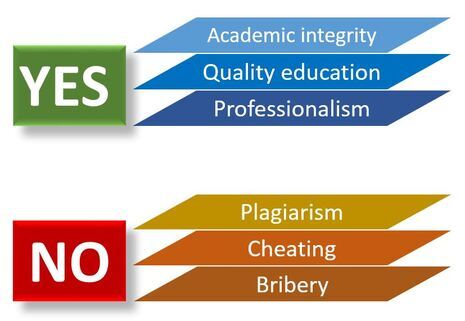
Principles and values
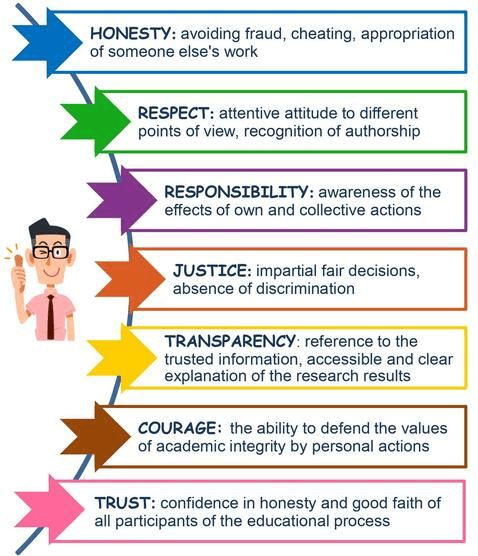
Volation of Academic Integrity |
Academic Responsibility |
|---|---|
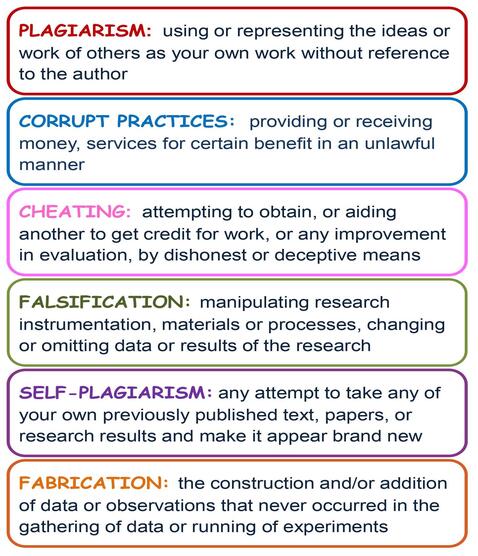 |
The normative documents that regulate the responsibility for violation of Academic Integrity norms are:
Students' Academic Responsibility:
Scholars' and Lecturers' Academic Responsibility:
|
According to the Law of Ukraine "On Education":
Academic Integrity a set of ethical principles and statutory rules that should guide the participants of the educational process in teaching, studying and conducting scientific (creative) activities in order to ensure confidence in the results of learning and/or scientific (creative) achievements.
Legislation
Law of Ukraine "On Academic Integrity"
Law of Ukraine "On Higher Education"
Internal normative base
Sumy State University Academic Integrity Codex
Regulations on Academic Integrity and Ethics of Academic Relations in Sumy State University
Methodical instructions for checking academic texts for text borrowing
Additional materials
Recommendations for academic integrity
An expanded glossary of terms and concepts of academic integrity
ACADEMIC PLAGATE the disclosure (part or in full) of scientific (creative) results obtained by other persons as the results of their own research (creation) and/or reproduction of published texts (published works of art) by other authors without specifying authorship.
Types of Copy & paste plagiarism: use the text of another author without change, without quoting and pretending to be his own work.
Shake & paste plagiarism: a combination of fragments of various texts or sentences for the formation of a new text without quoting, thus presenting it as one’s own thoughts.
Idea plagiarism: presentation of the ideas of another author in your own words, without reference to the source.
Translation plagiarism: translation of the original text from another language without reference to the source.
SELF-PlAGIARISM – submitting, in whole or in part, your own work which has previously been submitted elsewhere, without citing and referencing the earlier work.
Examples of self-plagiarism:
- duplication of publications – publication of one and the same scientific work (with or without minor changes) in several editions, as well as re-publication (with or without minor changes) of previously published articles, monographs, other scientific works as new scientific works
- duplication of scientific results – the publication of the same scientific results, in various articles, monographs, and other scientific works, as new results published for the first time
- representation in the reports on the implementation of scientific projects of the results contained in the previous works received as a result of the implementation of the project
- aggregation or addition of data – the combination of old and new data without their clear identification with the corresponding links to previous publications
- data disaggregation – the publication of parts of previously published data without reference to previous publication
- re-analysis of previously published data without reference to the previous publication of this data and their analysis previously performed
What is not Considered Plagiarism?
There are:
- Common knowledge and facts
- Idioms
- Ideas or definitions that are widespread and known
- Paraphrasing the content in your own words when translating from a dialect or another language, if there is no widely known phrase or accepted official translation
- News reports of the day or current event reports which are considered as ordinary press information
- Works of folk art (folklore)
- Official documents issued by public authorities (laws, decrees, decisions, court decisions, state standards, etc.) and their official translations.

1. Use paraphrasing
This method is the perfect solution when you know you have to cite the original source but can’t find it anywhere. You can’t just rewrite someone else’s thoughts and present them as your own. This isn’t how you avoid plagiarism. Even when you’re paraphrasing, you need to attribute ideas to their original authors. Just start the sentence by referencing the author and then continue sharing the thoughts or ideas.
2. Quote sources
When quoting, you need to make sure that the quote is written exactly as it appears in the primary source. And, of course, there have to be quotation marks. To make sure you’ve acknowledged the author of the extract, add a citation in brackets right after the quote you’re using.
You also have to keep in mind the length of the quote. Quotes longer than 40 words, or "block quotes", are typically no good. Having too many quotes in your work isn’t recommended either, as it makes the readers question your level of expertise.
3. Cite materials
This is one of the most effective ways to avoid plagiarism. This is because a proper citation contains all the necessary information about the original work and its author. To be able to cite the materials correctly, you need to be aware of the guidelines for the citation style your institution is using.
4. Add references
A reference list contains all the works that you’ve cited in your paper. A list of references also has a specific format, so you need to make sure that you’re using the proper style guidelines. The information in the reference list includes the author’s name, date of publication, title, and source. The exact order of those items and the presence of additional details are determined by the particular citation style you’re using.
5. Get invested in your topic
One of the most common reasons why students plagiarize works is that they aren’t interested enough in the topic they’re writing about. As a result, they don’t conduct enough research or put enough effort into finding original sources. It all ends up in a paper full of plagiarism. If the topic you have to write about isn’t interesting enough, try to find at least some aspects that capture your attention. This way, you’ll pay more attention while conducting research and gathering resources, both of which will improve the overall quality of your work.
6. Know what not to cite
To know when to cite sources, you also need to understand what does not need to be cited. You don’t have to cite information that is common knowledge or facts about well-known events. Personal experiences and urban legends also belong to that category. There is, however, one thing to remember, and that’s copyright. While common knowledge or facts themselves can’t be copyrighted, original or unique wordings can. So, even if you’ve found well-known facts, make sure to take extra precautions and interpret them in your own words.
7. Plan your work well before starting to write
When you have a well-designed and thought-through plan for your future work, you’ll be able to balance everything out much better. You’ll be able to see how many of your own thoughts are going to be in your paper and how much you’re planning to cite from other authors. A plan will also show whether or not you’ve found all the original sources you’ll need for your work.
8. Evaluate all the sources
Apart from finding the primary source of the information, you also need to evaluate how good that source actually is. This rule of thumb also applies to regular resources, not just online ones. So, to make sure the resource is worth using in your paper, pay attention to the following:
- How good is the author’s reputation in your field?
- Where did the author take the information from? What connection does he or she have with other organizations?
- When was the original work published? Is it still relevant and up to date?
- How well does the author support his or her own ideas? What’s the overall quality of writing, and how accurate is the provided information?
Considering these questions will help you decide whether the resource you’re about to use is reputable enough. Including questionable resources in your paper only increases the chances of having plagiarized information.
9. Don’t forget about online resources
Sources from the Internet also need to be cited properly. Many academic papers are published in online scientific magazines and periodicals. But they still fall under the protection of copyright laws, thus it must be cited. Also, before adding a citation, you need to make sure that the resource you’re referencing is the original one – not just one on its reference list. Otherwise, keep searching until you’ve found the primary source.
10. Leave enough time for research
Research is a vital part of the entire writing process. You could even consider it to be a separate task because of its great importance. Having enough time for writing and researching is by far the best way to avoid plagiarism. Time allows you to gather a great number of relevant resources, instead of using only a couple for your whole work.
One recommended practice is to write bulleted lists as you research, pointing out all the key ideas and findings from various works. Then you should take a break and return after some time.
It will also allow you to spot any flaws or inconsistencies, fill in any possible gaps in your argument, and rephrase some of your statements. You can do all of this without hurting the quality of your paper and without increasing the chances of including plagiarized material. All you need is more time for research.
All it really takes to avoid plagiarism is to focus on being as original as possible and sharing your own thoughts. So, to be able to succeed, you just need to have the right mindset. And with the help of our tips, your paper will be flawlessly free of plagiarism.
Recommendations for the prevention of academic plagiarism in scientific works (abstracts, theses, monographs, scientific reports, articles, master's and bachelor's theses, etc.).
- Any text fragment consists of a sentence or more, reproduced in the text of scientific work without changes, with minor changes, or translated from another source, must be accompanied by a reference to this source. Exceptions are allowed only for standard text clichés that are not authored and/or are commonly used
- If the paraphrasing or arbitrary retelling of the text in the text of the scientific work of another author (other authors) takes more than one paragraph, the reference (bibliographic and / or textual) to the relevant text and / or its author (s) should occur at least once in each paragraph of the scientific work, except for paragraphs consisting entirely of formulas, as well as numbered and bulleted lists (in the latter case, it is allowed to submit one reference at the end of the list)
- If a quote from a particular source is given by the original source, the reference to the original source should be given in the scientific work. If the quotation is not based on the original source, a reference to the direct source of citation (“cited from ______”) should be included in the text of the scientific paper
- Any given scientific and technical information in the text of scientific work should be accompanied by a clear indication of the source from which this information is taken. Exceptions are allowed only for well-known information recognized by the entire community of specialists of the relevant profile. In the cases of using a regulatory legal act, it is sufficient to indicate its title, date of approval and, if any exist, the date of adoption of the latest amendments to it or a new edition
- Any published works of art reproduced in the text of the scientific work must be accompanied by an indication of the authors and the title of these works of art (if known). In the case of performing arts, individual or collective performers (if known) should also be mentioned. If the authors/performers are unknown, it should be noted that they are unknown. In case of impossibility to identify the author, the title and/or performers of work, it is necessary to indicate the source from which the reproduced work is taken
Checking for the existence of text borrowings in academic texts is determined by the Regulations on Academic Integrity and the Ethics of Academic Relations in SumDU and precedes all other review procedures.
The procedure for verification of academic texts by anti-plagiarism systems is defined in Methodical Instructions for Verification of Academic texts for the Existence of Text Borrowings.
 Documents to be checked in accordance with paragraph 5 of the regulation:
-
- qualification works of applicants for higher education, term papers, abstracts
- textbooks, monographs, tutorials, lecture notes, distance courses, open online courses
- dissertations, articles, conference materials
- final research reports
Remember! By using free anti-plagiarism Internet systems, you provide all information about your research to a third, non-legally responsible person.
 Functions of anti-plagiarism systems:
-
- determine the degree of similarity (in percentage) of the academic text to the texts of documents contained in the University database (SSU), database exchange program (StrikePlagiarism system), database RefBooks (StrikePlagiarism system) and Internet resources.
- recognize a variety of text manipulation such as replacement of characters of the alphabet, the use of special software tools, replacing of text by graphic images, etc
- generate a detailed report of the similarity of the analyzed text
 Things to remember while working with Verification Systems:
-
- systems provide information that allows an independent assessment in relation to the correctness and legality of borrowing, to determine the percentage of originality of scientific work
- systems do not determine whether the work contains new scientific knowledge, research results or plagiarism
- works with high or low similarity percentage cannot be qualified as containing or not containing plagiarism
- the final decision on the existence of ideas and scientific results obtained by other authors and the reproduction of published texts of other authors without appropriate reference is made by the responsible competent person
 Verification systems used by the SumDU:


- are used to check all academic texts of the SumDU as defined in paragraph 5 of the Regulation
Subject librarians:


- Applied physics and nanomaterials
- Cybersecurity / Cybersecurity and information protection
- Computer Science
- Applied Mathematics
- Electronics / Electronics, electronic communications, instrumentation and radio engineering
- Electric Power, Electrical Engineering And Electromechanics / Electrical engineering
- Automation, computer-integrated technologies and robotics
- Micro- and Nanosystem Technique
- Telecommunications аnd Radio Engineering
- Biomedical Engineering
- Secondary education (Physics)
- Software engineering
- Tourism / Tourism and recreation
- Economics and international economic relations (by specialization)
- Accounting and taxation
- Finance, banking, insurance and stock market
- Management / Entrepreneurship and Trade
- Marketing
- Public management and administration
- Economics and International Economic Relations / Management